
News
Inside Luxembourg: Bretzelsonndeg
10 March 2026
By Isabelle Frisch-Koopmans
As Bretzelsonndeg approaches, I find myself thinking not only of sweet pastries and the first signs of spring, but also of how local traditions can help us feel at home in Luxembourg. Whether you have just arrived or have lived here for many years, I hope this edition of Inside Luxembourg offers you a gentle and inviting introduction to one of the country’s most charming seasonal customs.
A brief history of Bretzelsonndeg
Bretzelsonndeg in Luxembourg has its roots in a mid‑Lent custom with Christian and especially Catholic influences, centred around Laetare, the fourth Sunday of Lent. On this day, the strict fasting rules were traditionally relaxed, and people were allowed a more festive meal in which eggs and baked goods played a special role. Over time, local communities in Luxembourg and the surrounding Greater Region developed their own way of marking this “little Easter in the middle of Lent”, and Bretzelsonndeg emerged as one of these traditions.
From a religious and calendar perspective, this Sunday sits exactly in the middle of the Lenten season. It links the themes of preparation, hope and renewal with the first signs of spring. In Luxembourg, Bretzelsonndeg became part of this wider Lenten culture: a moment when the seriousness of fasting briefly gives way to joy, shared food and small gestures of affection. In the neighbouring cross‑border region, the day also became associated with giving and receiving eggs and other symbolic foods.
The sweet pretzel at the centre of the tradition is more than just a pastry. The typical Luxembourgish version is made from puff pastry or a similar light dough and is often seen as a symbolic figure. Some interpret its looping shape as two crossed arms in prayer, others as the intertwined arms of two people in love. The word “Bretzel/Brezel” is often linked back to a Latin term for “arm”, which supports this idea of folded or crossed arms. In both readings, the form of the pastry connects devotion, relationship and a sense of being held or embraced.
This symbolism helped the pretzel become a sweet token of affection – something that can express love, closeness and gratitude while still echoing its religious background (prayer, Lent, Easter preparation). Historically, more savoury pretzels existed as well, but in Luxembourg the sweet, decorated version gradually became the main form, fitting a celebration that is about festivity and emotional warmth.
The best‑known version of the custom today is a playful “feast of love” in the middle of Lent. Traditionally, a man offers a pretzel to the person he loves on Bretzelsonndeg; if the feelings are returned, she gives him eggs at Easter as a sign of acceptance. In leap years, the roles are reversed and it is the woman who gives the pretzel. This fits into a broader European pattern where young people used to exchange symbolic gifts around mid‑Lent, May and spring festivals in order to signal interest and affection.

Giving eggs at Easter connects Bretzelsonndeg to older customs of passing on eggs that had accumulated during the fasting period. Eggs, in many Christian and folk traditions, stand for new life, fertility and resurrection. If the pretend‑suitor is turned down, he receives an “empty basket” instead – a gesture that lives on in the Luxembourgish expression “de Kuerf kréien”, literally “to get the basket”, meaning to be rejected. When people speak about the age of the tradition, they often say that Bretzelsonndeg reaches back “as far as the Middle Ages”, even though there are no precise written records for a first year or a clear founding moment. What is clear, however, is that the custom grew within a Catholic cultural area in and around Luxembourg and has continued to evolve up to the present.
Through the combination of its timing on Laetare Sunday, the symbolic shape of the pretzel and the playful exchange of gifts between partners, Bretzelsonndeg today represents a very specific Luxembourgish form of a mid‑Lent celebration – one that brings together religious, social and culinary elements in a single sweet gesture.
Bretzelsonndeg today
In Luxembourg today, the fourth Sunday of Lent is still known as Bretzelsonndeg – Pretzel Sunday – and it remains a light‑hearted tradition that brings together food, feelings and a touch of humour. On this day, it is customary to give sweet, pretzel‑shaped pastries as a friendly or affectionate gesture. For some, it is a playful way to show appreciation or affection; for others, it is simply an excuse to enjoy a special treat with family and friends.
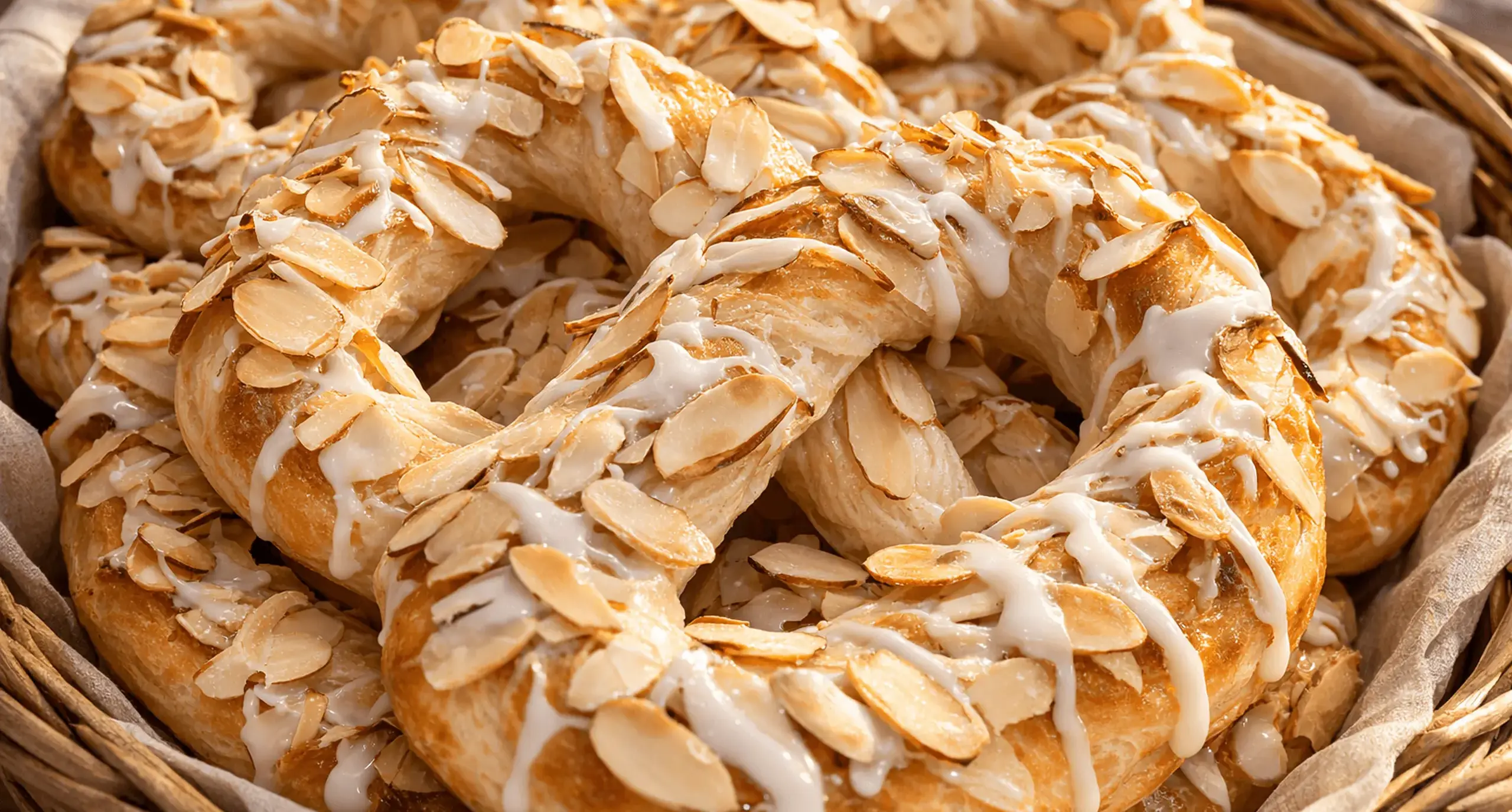
The pastry itself is usually made from a light, buttery dough, glazed with icing and often sprinkled with nuts or sugar. Its twisted shape, linked to crossed arms or clasped hands, fits the idea of closeness, togetherness and care. For many people, Bretzelsonndeg marks a cheerful moment in the middle of Lent, when days are slowly getting longer and the atmosphere becomes a little more festive again.
If you would like to try baking your own sweet Bretzels at home, you can follow this clear and family‑friendly video recipe by Anne Faber of Anne’s Kitchen:
Sweet Bretzel for Bretzelsonndeg – https://youtu.be/4BWjIJWytNo
Word of the Week
- Word: Bretzel
- Pronunciation: roughly “BREH-tsel”
- Example: “Hues du schonn deng Bretzel fir Bretzelsonndeg kaaft?” It means: “Have you already bought your pretzel for Pretzel Sunday?”
It’s a lovely word to help tune your ear to Luxembourgish, and a fun starting point for exploring more food-related vocabulary together.
A simple idea for families
Bretzelsonndeg is a wonderful opportunity to create a small celebration at home:
- Watch the recipe video together and let children help by naming ingredients or measuring spoonfuls.
- While the pretzels bake, create “pretzel cards” decorated with hearts, pretzel shapes or simple Luxembourgish words like Léift (love) or Merci.
- Once the pastries are ready, exchange the cards along with the pretzels – a sweet moment to say thank you, well done or simply “I’m glad you’re here”.
For younger children, salt dough works beautifully for shaping their own “pretzels”, which can be dried and painted afterwards.
As Bretzelsonndeg approaches, I hope you find a moment to enjoy a sweet pastry, learn (or practise) a Luxembourgish word and share a relaxed conversation at the table. Thank you for joining me on this small journey into everyday life in Luxembourg – and I wish you a Bretzelsonndeg filled with warmth, curiosity and the comforting smell of something freshly baked.
Léif Gréiss
– Isabelle
- This article is part of our “Inside Luxembourg” series, celebrating the stories, flavours and traditions that shape our local culture.
Further reading on Bretzelsonndeg and Lent traditions:
- Luxembourg.lu, “Bretzelsonndeg – a pretzel for love”, Government of the Grand Duchy of Luxembourg, accessed March 2026. https://luxembourg.public.lu/en/society-and-culture/festivals-and-traditions/pretzel-sunday.html
- JustArrived.lu, “Bretzelsonndeg Luxembourg: declare your love”, JustArrived, accessed March 2026. https://www.justarrived.lu/en/evenements/bretzelsonndeg-dimanche-des-bretzels
- Wikipedia, “Bretzelsonndeg”, accessed March 2026 (for general background)
- Brauchtum.de, “Laetare – a Sunday of Lent with many stories”, accessed March 2026 (for the Laetare context) https://www.brauchtum.de/de/fruehjahr/fastenzeit/unterseiten/laetare.html
- “Symbols of Lent: the pretzel”, article on the religious and symbolic meaning of the pretzel (arms, prayer, fasting), accessed March 2026 https://www.geheimnisakademie.de/blog/2019/03/10/symbole-der-fastenzeit-die-brezel/