
News
Inside Luxembourg: 200 years of written Luxembourgish
21 January 2026
By Isabelle Frisch-Koopmans
When we write Luxembourgish today, it feels natural – almost effortless. But if we look back through history, we discover that written Luxembourgish is surprisingly young. The journey from spoken dialect to recognised national language took centuries, and the first printed lines were small, courageous steps towards cultural self-expression.
This week, we'll explore how written Luxembourgish began, how it evolved, and why these early traces still matter.
The earliest written trace
The oldest known written testimony of a form of Luxembourgish is the medieval poem Yolande von Vianden, written in the early 14th century by Brother Hermann von Veldenz.
- It contains nearly 6,000 verses.
- It is written in Moselle Franconian, a linguistic ancestor of modern Luxembourgish.
- It still shows strong Middle High German influence.
Although not "Luxembourgish" in the modern sense, it is the first major text from our linguistic region – a reminder that the roots of our language reach far back into the Middle Ages.
The first printed Luxembourgish text
A true milestone came much later. On 10 December 1825, the Luxemburger Wochenblatt published what is considered the first continuous printed text in Luxembourgish:
Een aarmen Drénker – a poem translated from the French Les derniers vœux d'un ivrogne.
- It appeared in Antiqua script, not the Fraktur typeface used for German articles – a subtle signal of linguistic distinction.
- It was labelled En patois de Luxembourg, showing how Luxembourgish was still viewed as a dialect.
- Its tone was lively, emotional and full of dialect colour – the written echo of everyday speech.
This moment marked the beginning of Luxembourgish as a printed language, visible and shareable beyond the spoken word.
Why written Luxembourgish emerged so late
For centuries, Luxembourgish was almost exclusively a spoken vernacular.
- French dominated administration.
- German shaped education and written culture.
- Luxembourgish lived in homes, villages and markets – but not in official documents.
Only in the 19th century did a new linguistic self-confidence emerge. Key developments:
- 1912: Luxembourgish was mentioned in law for the first time.
- After 1945: Grammar and spelling began to be codified.
- 1984: Luxembourgish was officially declared the national language.
- 2023: It was anchored in the Constitution.
The path from dialect to national language was long – but steady.
From dialect to literature
The 19th century transformed Luxembourgish from an oral tradition into a written cultural language.
- In 1829, Antoine Meyer published E Schrek ob de' Lezeburger Parnassus, the first book in Luxembourgish. It included poems and one of the earliest attempts to describe Luxembourgish grammar and orthography.
- Michel Rodange (1827–1876), born in Waldbillig, is celebrated as Luxembourg's national poet. His epic satire Renert (1872), a retelling of the medieval Reynard the Fox in Luxembourgish, is considered the linguistic and literary high point of 19th-century Luxembourgish literature. Rodange also worked on Ons Hemécht, alongside Nik Welter.
- Michel Lentz (1820–1893), born in the same year as Dicks, is best known for writing the text to Luxembourg's national anthem, Ons Hemécht (1859), and for his poem De Feierwon (also 1859), which contains the famous line: "Mir wëlle bleiwe wat mir sinn" – a phrase that has become an unofficial national motto expressing Luxembourg's desire to remain true to its identity.
- Edmond de la Fontaine, known as "Dicks" (1823–1891), was a poet, composer, and actor who brought Luxembourgish into the theatre and onto the stage. His folk comedies and songs made Luxembourgish accessible and beloved, giving it a voice in popular culture.
These pioneers laid the foundation for a written language that could carry poetry, humour and identity.
The first Luxembourgish dictionaries
As Luxembourgish gained visibility in print, scholars began documenting the language more systematically.
1847 – Wörterbuch der Luxemburgischen Mundart
One of the earliest Luxembourgish dictionaries collected words from everyday speech and marked an important step toward linguistic documentation.
Other important milestones:
- Meyer's grammar notes in 1829
- Growing lexicographic interest at the end of the 19th century
- Post-1945 efforts to standardise spelling and pronunciation
A full overview of historical and modern Luxembourgish dictionaries is available here.
These works show that long before Luxembourgish became a national language, people were already working to preserve and legitimise it.
Luxembourgish classic for children
|
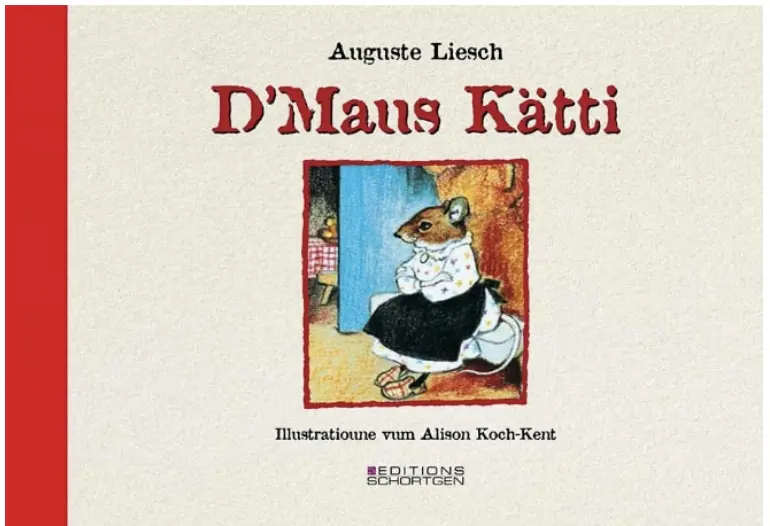
Many children in Luxembourg grow up with the story of D'Maus Ketti by Auguste Liesch – a real classic of Luxembourgish literature. In this fable, a country mouse visits her cousin in the city and discovers that a "better" life is not always safer or happier. The story is easy to read in Luxembourgish and works wonderfully as a read-aloud text at home. It opens the door to conversations with children about city and countryside, comfort and risk, and about what "home" really means. For interested families, there are modern, child-friendly editions and even simple bilingual versions available (Lëtzebuergesch with another language), which can support both language learning and family reading time. Click here for more information about the book. |
 |
Word of the Week
Word: schreiwen
IPA: /ˈʃʁaɪ̯vən/
Origin: Germanic roots, related to German schreiben
Example: "Si huet gär op Lëtzebuergesch geschriwwen." In English, it means "She enjoyed writing in Luxembourgish."
Historical note: Early writers used many spellings – even Zeitung appeared as Zeitong.
The first written lines in Luxembourgish were more than just words. They were a declaration of identity, a quiet joy in one's own voice – and the beginning of a written culture that continues to grow today.
– Isabelle Frisch-Koopmans
- This article is part of our “Inside Luxembourg” series, celebrating the stories, flavours and traditions that shape our local culture.
Sources
- Michel Lentz, "De Feierwon" (1859), Refrain: "Mir wëlle bleiwe wat mir sinn"
- Government of Luxembourg – official biographies of Michel Rodange, Edmond de la Fontaine ("Dicks"), and Michel Lentz
- Overview of Luxembourgish dictionaries: https://infolux.uni.lu/worterbucher/
- Döhmer, Johannes. Aspekte der luxemburgischen Syntax
- Historical documentation on Antoine Meyer and early Luxembourgish literature