News
Dr Guy Sutton Returns for the Fifth Year Running!
18 October 2016
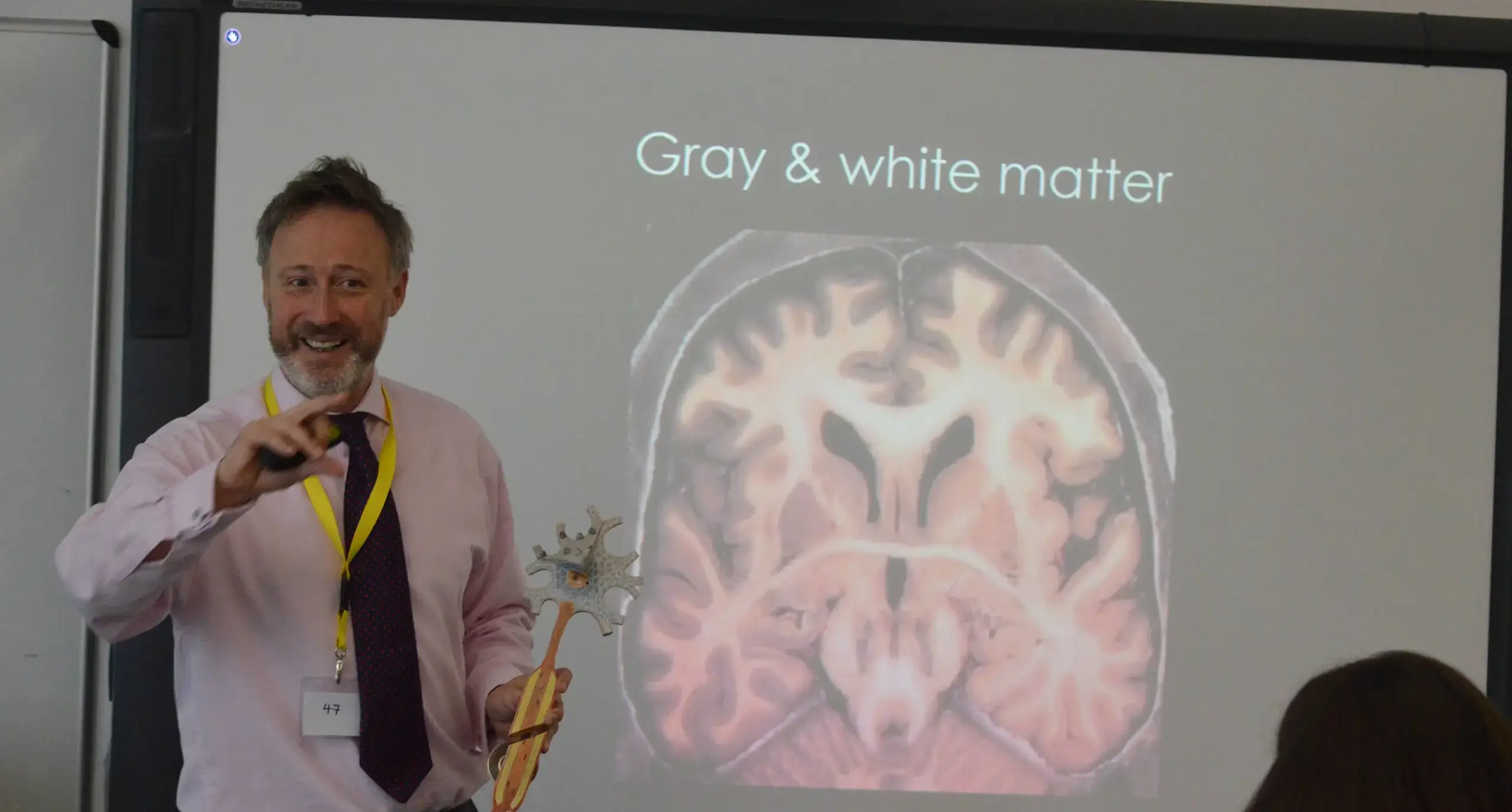
On 13th and 14th October 2016, Dr Guy Sutton visited the school for Brain Awareness week for the fifth year running. Dr Sutton is an Honorary Assistant Professor at the University Of Nottingham School Of Medicine. His visits to St George’s are always inspiring and allows students to experience academic lectures that go beyond A-level examinations and Text books in preparation for university study. The theme this year was ‘The Criminal Brain’. He spent a day with psychology students exploring the basics of Forensic psychology which included, offender profiling and perspectives on criminality and the profile of the Zodiac Killer was used as a case study to bring it all together. The second day he spent with the Biology students exploring epigenetics and DNA analysis in crime scenes. The highlight of the day was the dissection of a sheep’s brain. Dr Sutton also gave an informative evening lecture to members of the public by providing examples of how changes in brain structure and function may be linked to deviant behaviour and addressing the crucial relationship between the social world and our individual makeup.
Article written by St George's Student
St George’s welcomed Dr Guy Sutton a neurologist who works with the University of Nottingham Medical School and Cambridge University. He spent the day with our A level biology students. Here are some reflections of the day from one of our year 12 students.
“Dr Guy Sutton visited our school on Friday and the students in the sixth form had the wonderful opportunity of spending an entire day with him, exploring various realms of biochemistry, forensics and biological sciences in a series of talks and activities which even included a brain dissection!
The day started with an introductory talk on the 21st century definitions of heath and disease, connecting it with some genetic and epigenetic notions: due to this we had the opportunity to explore topics not covered in A-level curriculum but which are of great importance and focus in individualised medicine and modern treatment of illness at present. The genetic make-up of some cancers and pharmaceuticals aimed at treating them were also talked about. Dr Sutton was very well-versed and widely-read on the subject and addressed any questions which arose on this (and other) topics very efficiently and comprehensibly. We also looked at various brain structures and mechanisms in a great presentation, we even had a taste of some university level work when Dr Sutton tackled the transport of electrical impulse in nerve cells and how synapses work, which was truly fascinating. One of the highlights of the day was undoubtedly the sheep brain dissection. Dr Sutton carried out in front of us: we got to experience and visualise the complex but beautiful structures of the brain first-hand (the brain was also carefully passed round for everyone to get a closer look). Near the end of the day the topic shifted to forensics, a field of science looking at criminals and crimes (not for the faint of heart!) and Dr Sutton related some of his experiences in the field and what amazing methods scientists are able use nowadays to catch culprits or understand how crimes happen. An interesting, but not very well-known, field of forensics which I thought interesting was forensic entomology, in other words, the use of insects that live and thrive on decomposing bodies to aid legal investigations.
Personally, I thought the most interesting part was the one on epigenetics and the biochemistry of cancer and how the two affect each other, in our bodies everything is connected and being able to look at such an infamous disease from this new perspective is very stimulating, it is also interesting to see how genetic mechanisms are being targeted by new, powerful drugs to cure this horrible malady. Additionally, it is fascinating to think that we are determined by our genes but only to a certain extent and that factors like the environment, diet and other lifestyle choices influence who we are. This eradicates the notion that we are predestined to follow a certain path set to us by our genes. All in all, Dr Sutton was extremely interesting and engaging and I’m sure everyone came out of school that day with a smile on their face and something to think about.” - Marina S.